

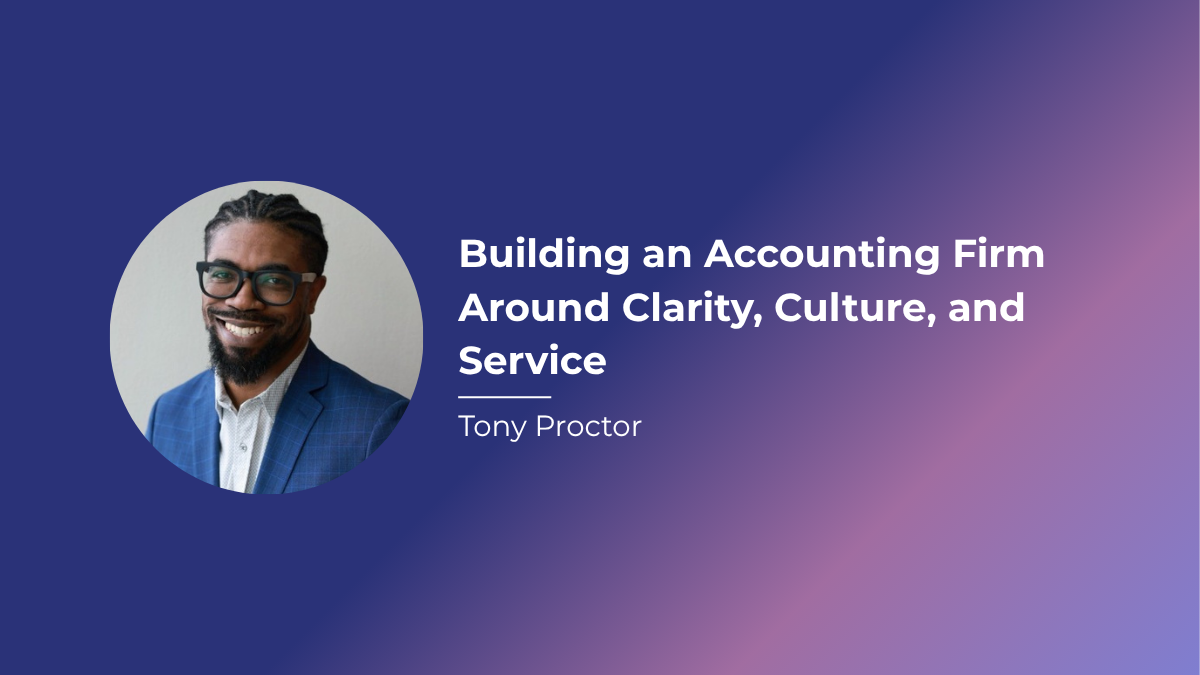
Tony Proctor is an EA and accounting firm owner based in Charlotte, North Carolina. After starting with tax work for friends, family, and early clients, he built a firm centered on clarity, responsiveness, and strong relationships. His story reflects how modern accounting firms grow by combining people-first culture, structured workflows, and practical communication.
Tony’s path into accounting started early. He describes himself as the “number nerd” in his family, someone who genuinely enjoyed working with numbers and understanding how things worked.
Like many professionals, his original plan looked different. He initially pursued a path toward medicine, but over time realized that accounting better aligned with his strengths.
More importantly, he saw an opportunity.
Many clients didn’t need more complex reporting. They needed clarity — someone who could explain their numbers in a way that actually helped them make decisions.
That insight became foundational to how he built his firm.
Tony’s firm didn’t start with a big launch. It started with trust.
He began by helping friends and family with tax work, gradually building a client base through relationships and referrals.
At one point, he was balancing a full-time job while building his firm on the side — taking meetings during lunch breaks and after work.
His first larger clients came from real estate and professional services, which helped shape the early direction of the firm.
This type of organic growth is common among small accounting firms, where early traction comes from:
A core principle in Tony’s approach is clarity.
Many accounting firms focus heavily on technical delivery, but clients often leave conversations without fully understanding their financial situation.
Tony’s focus is different.
He prioritizes:
Because when clients understand their numbers, they make better decisions.
Tony describes his firm culture as “casually business.”
The work is taken seriously, but the environment is human.
He emphasizes:
This reflects a broader shift in accounting.
Firms are no longer just optimizing for output. They’re also optimizing for people and culture, which directly impacts retention and long-term performance.
One of Tony’s biggest shifts as a firm owner has been moving away from perfectionism.
Earlier in his career, he often overanalyzed decisions, waiting for the perfect moment or the perfect plan.
Now, the focus is on progress.
Making decisions faster. Adjusting as needed. Improving through action.
For firm owners, this is critical.
Waiting for perfect systems often slows growth more than imperfect execution.
Tony’s philosophy on balance is simple: be present where you are.
When working, focus fully on the work.
When with family, be fully there.
He reinforces this mindset with his team by reminding them that while accounting is important, it is not emergency work.
This perspective helps reduce burnout and creates a more sustainable work environment.
It also connects with a broader trend in the industry, where more professionals are prioritizing flexibility and quality of life — similar to the shift toward work-life balance in remote accounting jobs.
Tony is clear about one thing:
Being a great accountant is not the same as being a great firm owner.
Running a firm requires managing:
Many new firm owners underestimate this shift.
Success comes not just from technical skill, but from the ability to manage the business as a whole.
Tony was an early adopter of AI, influenced by his background in technology.
His perspective is simple: firms that ignore technology risk falling behind.
However, the goal isn’t just speed.
It’s using technology to improve:
As firms become more tech-enabled, many also explore working with a nearshore accounting company.
This allows firms to maintain internal control while expanding capacity through structured support.
Tony’s story reflects a broader shift in how accounting firms operate.
Today’s firms are combining:
Many firms support this by integrating nearshore accounting professionals who handle preparation work while internal teams maintain review workflows and final sign-off.
This becomes especially valuable during high-demand periods, where firms need to maintain service quality without overloading internal teams.
For example, many firms start by implementing tax season workflow support.
Tony’s journey shows that building a strong accounting firm is not just about technical expertise. It’s about clarity, relationships, and consistent execution over time. As firms evolve, those that focus on communication, culture, and adaptable operating models are the ones best positioned for long-term growth.
If you’re exploring how to build a more responsive accounting firm with scalable support, learn how South Offices helps U.S. firms build nearshore accounting teams in Latin America.
